The Science Behind Visual Timers: Why Your Brain Loves Seeing Time
Explore the psychology and neuroscience explaining why visual timers are so effective. Learn about visual processing, temporal perception, and cognitive load theory.
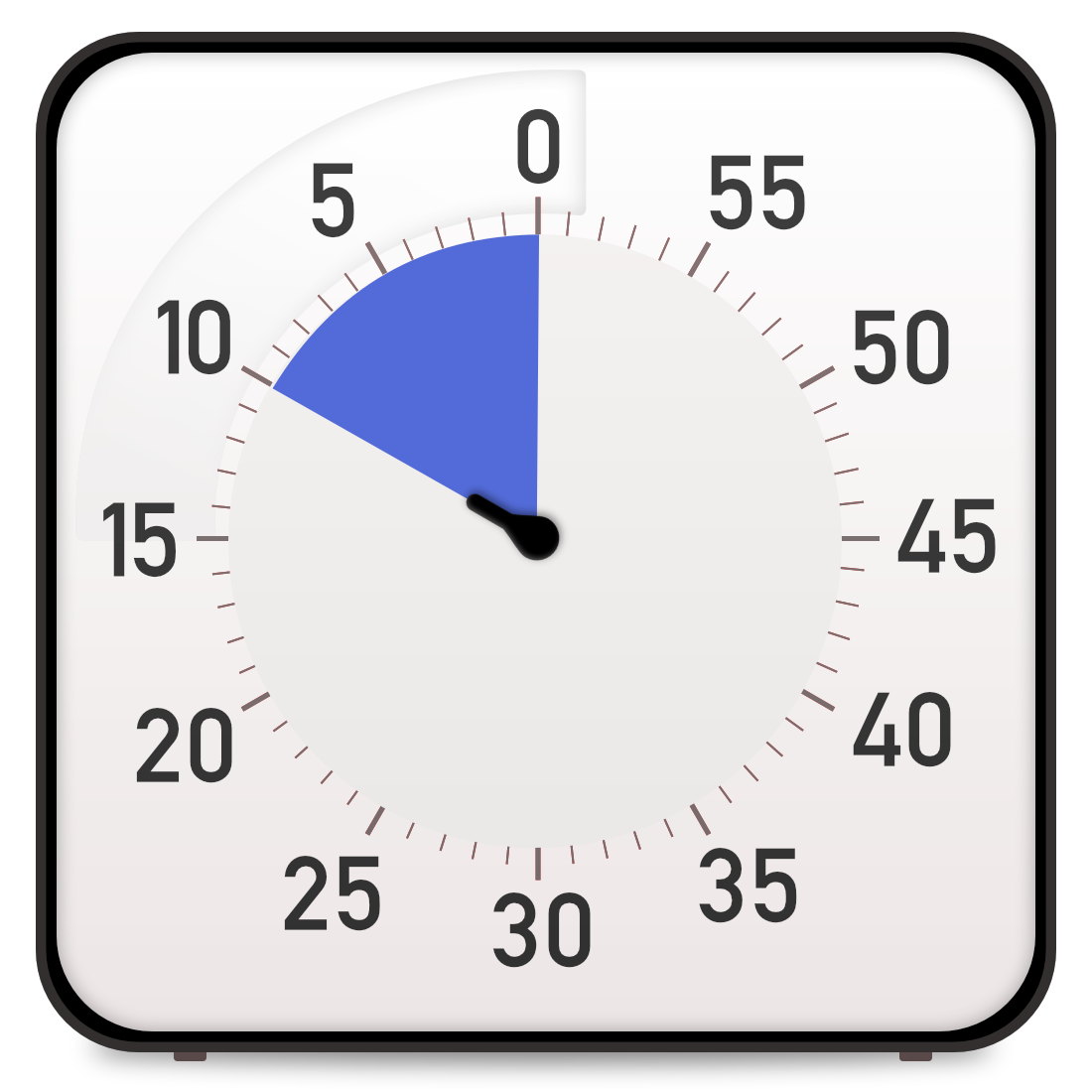
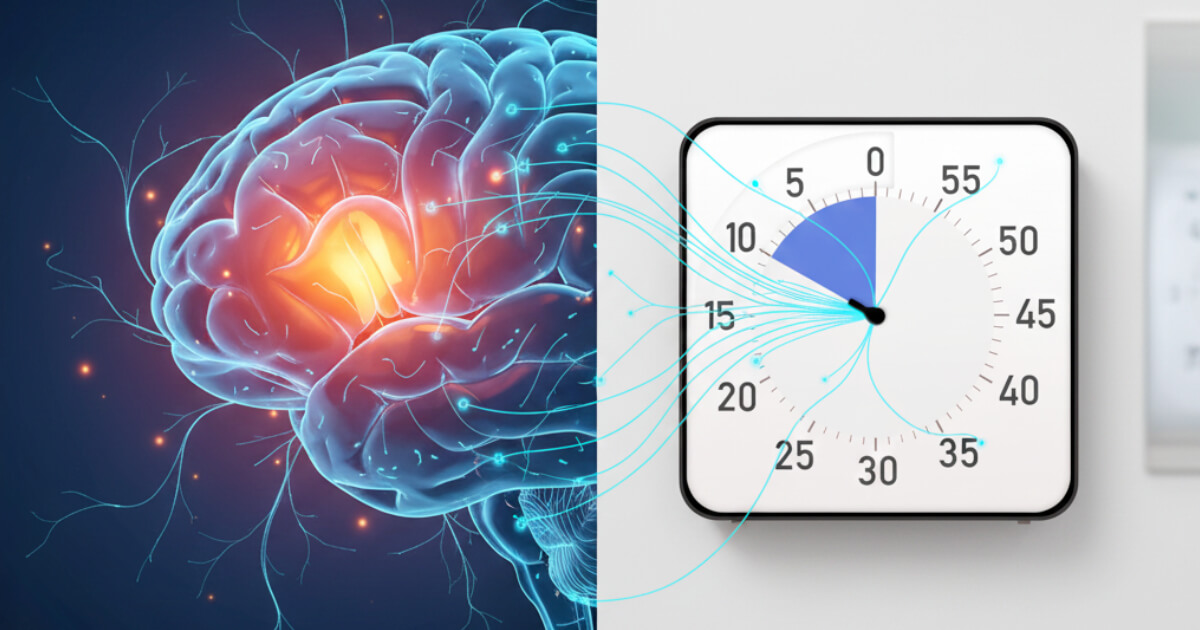
Why do visual timers work so much better than simply checking a clock periodically? The answer lies in fundamental principles of neuroscience and cognitive psychology. The human brain processes visual information 60,000 times faster than text, and visual representations access different neural pathways than numerical or linguistic information. When you see a shrinking colored section on a visual timer, your brain instantaneously understands 'time is passing and approaching zero' without any conscious calculation or interpretation. This effortless processing is why visual timers feel intuitive even on first use. The effectiveness of visual timers draws on multiple areas of cognitive science: visual processing superiority, reduced cognitive load, spatial-temporal integration, and the psychology of progress visualization. Understanding the science behind these tools helps explain not just why they work, but how to use them most effectively.
Visual Processing Speed and Efficiency
The visual cortex occupies about 30% of the human brain, compared to 8% for touch and 3% for hearing. This massive neural real estate exists because vision is our dominant sense for gathering information about the world. Visual information travels from the retina through the optic nerve to the visual cortex within 13 milliseconds, and initial processing happens unconsciously and automatically. When you look at a visual timer, your brain does not need to actively decode symbols or perform calculations - the visual pattern directly represents the concept. Neuroimaging studies using fMRI show that processing visual representations of quantity and progress activates the visual cortex and parietal regions responsible for spatial awareness, creating understanding with minimal frontal lobe involvement. In contrast, reading a digital clock requires the frontal cortex to interpret numerical symbols, access time knowledge to understand what the numbers mean, perform mental arithmetic to calculate remaining time, and then translate that into practical meaning. This multi-step process uses significantly more cognitive resources and occurs consciously rather than automatically. The visual timer shortcut means you can monitor time while dedicating mental resources to your actual task rather than time management. This is why people consistently report that visual timers feel less intrusive than checking clocks - they require almost no attention to provide time awareness.
Cognitive Load Theory and Mental Resources
Cognitive load theory, developed by educational psychologist John Sweller, explains that working memory has limited capacity and any unnecessary mental effort reduces performance on primary tasks. Every time you check a regular clock, you expend cognitive resources on time calculation: What time did I start? What time is it now? How much time has passed? How much time remains? Is that enough time? These calculations pull mental resources away from the task you are trying to focus on. For complex cognitive work like writing, problem-solving, or learning new material, this repeated drain on working memory significantly impairs performance. Visual timers reduce cognitive load by eliminating these calculation steps. The visual representation provides instant information about time status without requiring active mental processing. Your working memory remains available for your actual task. Research on dual-task performance shows that people can maintain focus on primary tasks much better when secondary monitoring tasks (like time awareness) use different sensory channels or require minimal processing. A visual timer in peripheral vision provides passive time monitoring that does not compete with the focused attention required for most work or learning tasks. This is particularly important for individuals with ADHD or other executive function challenges, who have reduced working memory capacity and benefit enormously from anything that reduces cognitive load. By making time monitoring automatic rather than effortful, visual timers free up precious mental resources for productive work.
Spatial-Temporal Integration
One of the most fascinating aspects of visual timer effectiveness is how they leverage the brain's spatial-temporal integration abilities. The human mind naturally understands spatial analogies for abstract concepts - we describe time using spatial language: 'a long day,' 'approaching deadline,' 'time running out.' Neuroscientific research shows that the brain areas responsible for spatial navigation and temporal processing significantly overlap, particularly in the hippocampus and parietal cortex. When visual timers represent time as a physical quantity that shrinks or depletes, they activate this integrated spatial-temporal processing system. Your brain treats the colored section of a timer similarly to how it processes physical distances or quantities you can see. Studies on magnitude representation show that the brain's approximate number system, which allows us to quickly estimate quantities, responds to visual representations of time just as it does to spatial extent or object quantity. This is why you can glance at a visual timer and immediately know 'about half done' or 'almost finished' without any conscious estimation. The circular or linear format of visual timers also maps onto innate spatial understanding - circles filling or emptying, lines progressing from start to end. These formats align with schemas the brain develops from countless experiences with containers filling, journeys completing, and circular cycles progressing. This deep cognitive resonance explains why visual timers feel natural and intuitive across cultures and age groups, requiring minimal learning or explanation.
Progress Visualization and Motivation
The psychology of progress is a powerful motivational force that visual timers harness effectively. Research on goal pursuit shows that people experience increased motivation and engagement when they can see progress toward completion. This is called the 'goal gradient effect' - the tendency to increase effort as the finish line approaches. Visual timers create this effect for every time-bounded task. As the colored section shrinks toward zero, your brain receives continuous feedback that you are making progress, that the endpoint is approaching, and that completion is achievable. This progress visibility combats procrastination and helps maintain focus through difficult tasks. The psychological concept of 'small wins' also applies - completing a visual timer session provides concrete evidence of accomplishment, building momentum for subsequent sessions. Behavioral psychology research demonstrates that visible progress increases task persistence significantly compared to progress that must be mentally tracked. Teresa Amabile's research on the progress principle shows that of all events that engage people at work, the single most important is making progress in meaningful work, and visual indicators of that progress amplify the motivational effect. Visual timers also address what psychologists call 'temporal discounting' - the tendency to devalue future outcomes compared to immediate ones. By making the future endpoint visible and approaching, timers reduce temporal discounting, helping maintain focus on longer-term goals despite immediate distractions.
The Neuroscience of Time Perception
Understanding how the brain perceives time illuminates why external time representations are so valuable. Time perception involves a complex network including the prefrontal cortex for time estimation and planning, the basal ganglia and cerebellum for creating internal timing signals, and the striatum for duration discrimination. Unlike senses such as vision or hearing, which have specific receptor organs, time perception emerges from integrated neural activity across multiple brain regions. This distributed processing makes time perception vulnerable to disruption from stress, cognitive load, emotional state, and various neurological conditions. When you are focused on a task, time perception becomes less accurate because the same neural resources needed for time estimation are engaged in the task itself. This is why people commonly lose track of time during focused work - the prefrontal resources managing time awareness are busy with task execution. Visual timers provide a solution by externalizing time representation. Instead of requiring internal neural resources to track and estimate duration, you can rely on the external visual display. This is an example of 'extended cognition' - using external tools to supplement or replace internal cognitive processes. The visual timer essentially becomes a prosthetic time sense, continuously available without requiring dedicated neural resources. For individuals with conditions affecting time perception - ADHD, autism, certain learning disabilities, traumatic brain injury - this external time representation is not just helpful but often necessary for functional time management.
Conclusion
The science behind visual timers reveals why they are so much more than just another productivity tool - they are cognitive technologies that work with fundamental brain architecture rather than against it. By leveraging the visual system's processing speed, reducing cognitive load, activating spatial-temporal integration, providing visible progress, and compensating for the distributed nature of time perception, visual timers address multiple aspects of how the brain processes and responds to time information. This scientific foundation explains the consistent reports of effectiveness across diverse populations, from students to professionals to individuals with neurodevelopmental conditions. Understanding these mechanisms also suggests best practices: keep timers visible, use visual formats that show depletion clearly, maintain consistent durations for similar tasks to build temporal calibration, and trust the external representation rather than trying to also track time internally. Whether you use a physical timer or digital option like Focus Clock, you are implementing a tool grounded in solid cognitive science principles that genuinely enhance human performance and time management.
Try Focus Clock
Ready to improve your time management with visual timers? Focus Clock is a free online visual timer that helps you stay focused and productive.
Start Using Focus Clock