Time Blindness: Why You Need a Visual Timer (Not Just Another App)
Understanding time blindness and why visual timers provide the specific support needed. Explore the psychology and neuroscience behind why traditional time management fails.
Have you ever sat down for 'just five minutes' only to look up and discover an hour has passed? Or estimated a task would take 15 minutes but actually needed an hour? If so, you have experienced time blindness - a genuine neurological condition affecting millions of people, particularly those with ADHD, autism, or certain learning differences. Time blindness is not laziness, poor planning, or lack of discipline. It is a difference in how the brain processes temporal information, making abstract time nearly impossible to perceive accurately. While dozens of productivity apps promise to solve time management problems with notifications, reminders, and scheduling features, they all miss the fundamental issue: if your brain cannot accurately perceive time passing, more digital alerts just create more noise. Visual timers, by contrast, address the root problem by making invisible time visible and providing the continuous feedback that time-blind brains need.
The Neuroscience of Time Perception
Time perception, technically called chronoception, is a complex cognitive function involving multiple brain regions working in coordination. The prefrontal cortex plays a crucial role in estimating duration and planning across time, while the basal ganglia and cerebellum help create our internal clock. The suprachiasmatic nucleus regulates circadian rhythms, providing our sense of daily time. In individuals with time blindness, one or more of these systems functions differently, creating a disconnect between actual time passage and perceived time passage. Neuroscientific research using fMRI scans shows that people with ADHD, for example, have reduced activation in the prefrontal cortex during time estimation tasks and different dopamine regulation patterns that affect temporal processing. This is not a minor quirk - it is a fundamental difference in neural architecture. The brain regions responsible for attention, executive function, and reward processing all influence time perception, which is why conditions affecting these systems often include time blindness as a symptom. Understanding this neurological basis is crucial because it explains why traditional time management advice often fails. Telling someone with time blindness to 'just check the clock more often' is like telling someone with vision problems to 'just look harder' - it does not address the underlying processing difference.
Why Traditional Time Management Fails
Standard productivity advice assumes everyone has accurate internal time perception. Set deadlines, break tasks into chunks, estimate how long things take, plan your day in hourly blocks - all of these strategies require the ability to accurately perceive and estimate time, the very skill that time blindness impairs. Digital calendars and reminder apps add external structure, but they only ping you at specific moments. If you cannot perceive the hour between 2 PM and 3 PM, a notification at 2 PM does not help you understand how much time remains or how quickly it is passing. Multiple alarms or frequent reminders create alert fatigue and anxiety without building actual time awareness. Task management apps that estimate duration are only as good as your time estimation ability - garbage in, garbage out. The fundamental flaw in app-based solutions is that they provide discrete points of information (notifications, reminders, alerts) rather than continuous feedback about time passage. For someone without time blindness, a 3 PM reminder for a 4 PM meeting is sufficient - their brain tracks the intervening hour. For someone with time blindness, that hour disappears into hyperfocus or fragments into perceived minutes, and suddenly the meeting has started. What time-blind individuals need is not more interruptions but constant, passive access to time information that requires no effort to interpret.
How Visual Timers Provide Continuous Feedback
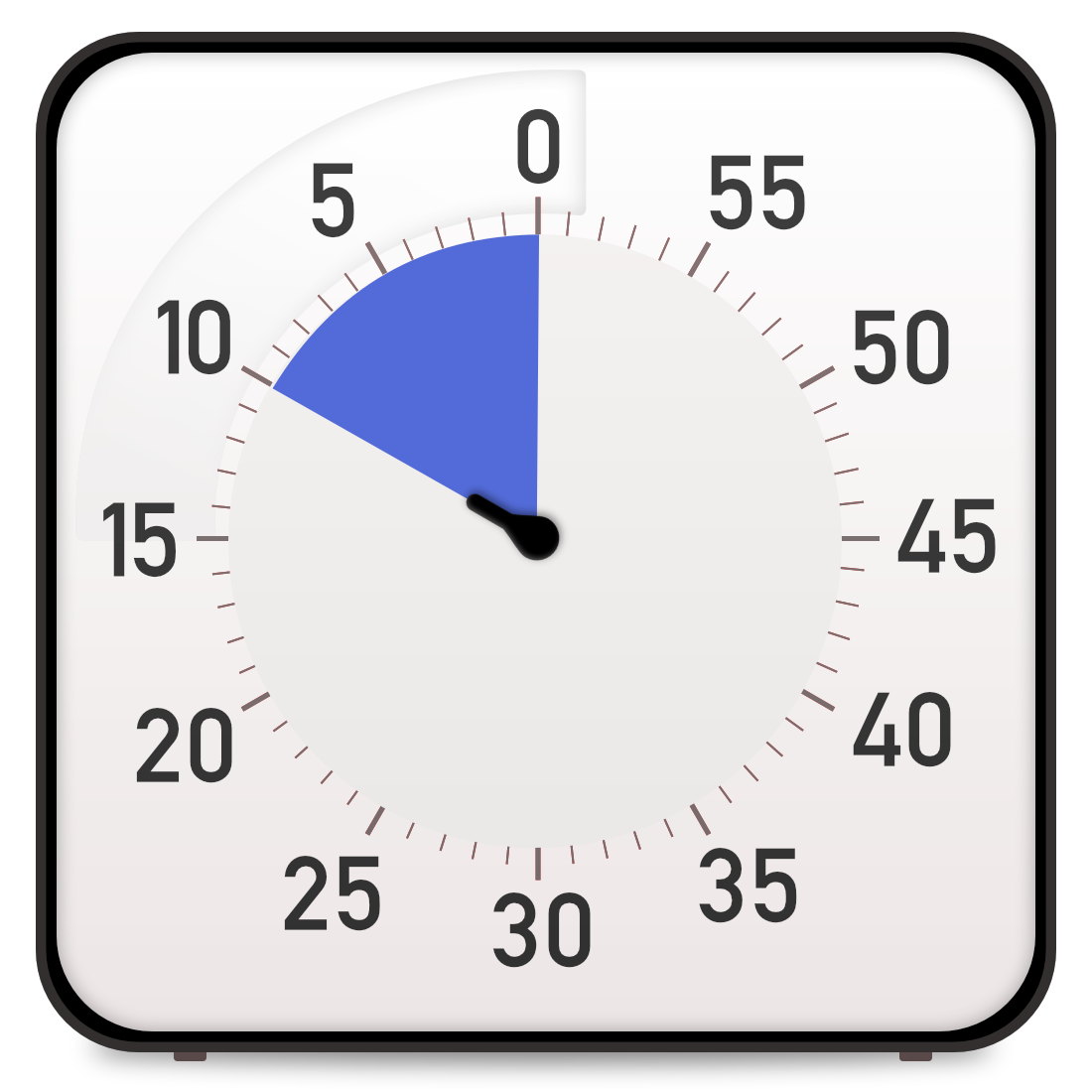
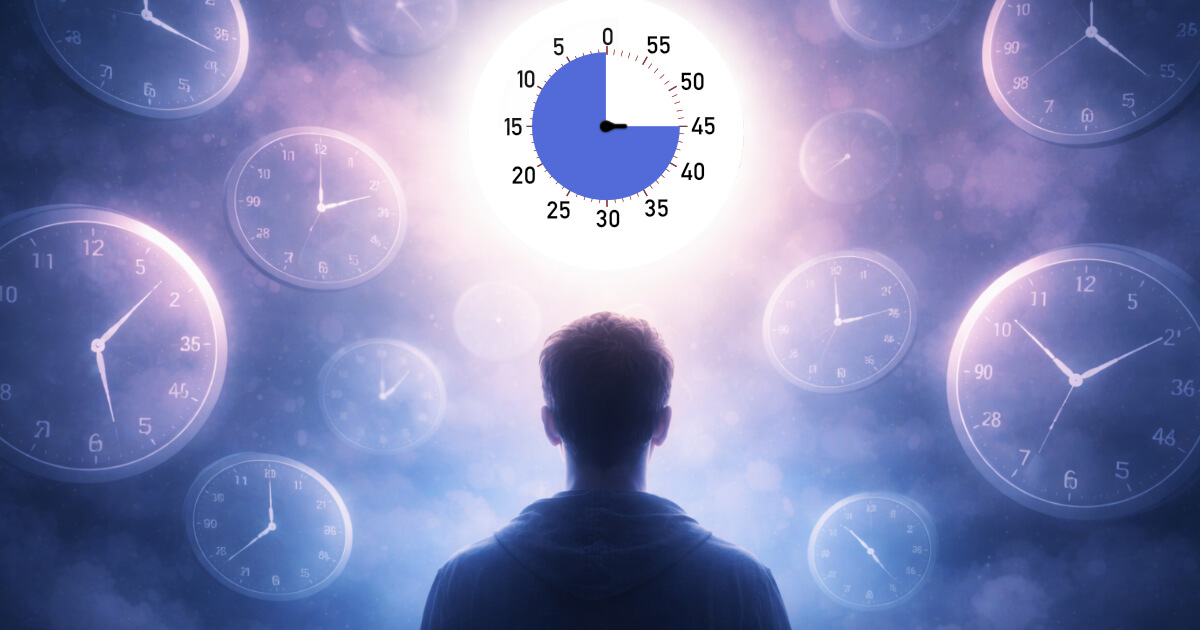
Visual timers solve the time blindness problem through continuous visual feedback that requires minimal cognitive processing. Unlike a digital clock showing numbers you must interpret, or reminder apps that ping intermittently, a visual timer provides instant, intuitive understanding of time status. The shrinking colored segment or counting-down pie chart gives your brain constant access to temporal information through the visual system, which processes information faster and with less executive function than reading and interpreting numbers. This continuous feedback creates what psychologists call 'external scaffolding' for the impaired internal time sense. Just as physical scaffolding supports a building under construction, the visual timer supports time perception while internal awareness is developing or unavailable. The passive nature of this support is crucial - you do not have to remember to check it or actively calculate remaining time. A glance in peripheral vision instantly conveys time status. This works with the time-blind brain rather than against it. The timer also provides what neuroscientists call 'salient cues' - information that naturally draws attention without requiring deliberate focus. As the colored section shrinks, your visual system automatically processes this change, keeping time awareness in your peripheral consciousness even during hyperfocus. This is fundamentally different from and more effective than apps that require you to actively engage with time tracking throughout the day.
The Psychology of Visible Endpoints
Beyond the neurological benefits, visual timers provide crucial psychological support through visible endpoints. One of the most debilitating aspects of time blindness is the anxiety and overwhelm that comes from activities feeling endless. When you cannot perceive time passing, tasks feel like they might continue forever, creating resistance to starting and difficulty persisting. The visual timer addresses this by making the endpoint concrete and approaching. You can literally see the finish line getting closer with every passing minute. This reduces the psychological burden of open-ended commitment and makes it easier to engage fully with challenging tasks. The phenomenon is well-documented in behavioral psychology: people perform better and feel less stressed when they can see progress toward a clear goal. Marathon runners speed up when they see the finish line; students focus better when they can see the period ending soon. The visual timer creates this same psychological effect for any time-bounded activity. Additionally, the timer serves as a commitment device - a psychological tool that helps follow through on intentions. By setting the timer, you are making a concrete agreement with yourself for a specific duration. The visible countdown holds you accountable to that commitment while also reassuring you that the commitment has limits.
Building Better Time Awareness Over Time
While visual timers primarily serve as compensatory tools, consistently using them can actually improve internal time awareness gradually. This is not about curing time blindness but rather building better calibration through repeated exposure to accurate time information. Each time you use a visual timer and experience what 25 minutes or 45 minutes actually feels like, your brain logs that data point. Over months and years, these accumulated experiences create better time estimation, not because the underlying neurology changes, but because you build a rich reference library of temporal experiences. Psychologists call this 'duration learning' - the process of developing more accurate time sense through feedback. The key is consistent use across similar activities. If you always use a 20-minute timer for morning routines, you develop a sense of '20-minute morning time.' If you use 45-minute timers for focused work, you build understanding of '45-minute work time.' This calibration is activity-specific and context-dependent, which is why varied and consistent timer use creates the best results. Importantly, this improvement supplements rather than replaces the timer. Even with better calibration, the visual feedback remains valuable because time blindness is a persistent neurological difference, not a skill deficit that can be fully overcome through practice.
Conclusion
Time blindness is a real neurological difference that requires real accommodations, not just more productivity apps or better discipline. Visual timers provide the specific type of support that time-blind brains need: continuous, passive, visually intuitive feedback about time passage and remaining duration. Unlike apps that ping you intermittently or require active engagement, visual timers work with your brain's visual processing strengths to create constant time awareness. Whether you use a physical timer or an online tool like Focus Clock, the key is consistent application across different areas of your life. Start with activities where time blindness causes the most difficulty - morning routines, work sessions, or transition times - and experience how visible time transforms your ability to function. Remember, needing external time support is not a personal failing; it is a smart strategy that accommodates genuine neurological differences. The goal is not to fix yourself but to find tools that help you succeed with the brain you have.
Try Focus Clock
Ready to improve your time management with visual timers? Focus Clock is a free online visual timer that helps you stay focused and productive.
Start Using Focus Clock